Employment and service sectors · DP073
Employee data and the employment-related legitimate use provision
Use the employment-related provision for the activity it actually covers, while preserving the rest of the privacy assessment.
Research cutoff: . This dated explainer is general information; check the linked instruments and your circumstances before acting.

Payroll, access control, benefits and a public recruitment campaign can all involve employees’ information. They do not automatically have the same purpose. A useful reading of the DPDP employment provision begins by separating those activities instead of assigning one legal label to the whole HR database.
The provision can support important employment-related processing within its terms. It should not be presented as a blanket exemption for anything an employer wants to do with staff data.
What the clause actually addresses
Section 7(i) includes processing for employment purposes or purposes related to safeguarding an employer from loss or liability. Its examples include protecting trade secrets and intellectual property and providing a service or benefit sought by an employee. Read the full wording against the specific activity you are considering.
As of 22 October 2026, section 7 and the relevant substantive duties are scheduled for 13 May 2027 under the commencement notification. The clause is part of the notified future framework, not a reason to ignore current applicable employment, confidentiality or privacy requirements during the transition.
Under the future section 4 framework, consent and the Act’s specified certain legitimate uses are distinct processing routes. Do not replace section 7(i)’s actual terms with a general ‘business interest’ test borrowed from another law.
Build a purpose map for employee data
List the activity, the data involved, the person affected, the recipient and the reason the activity fits the provision. For payroll, that reasoning may be straightforward. For a new monitoring tool, a public staff profile or an unrelated marketing use, the analysis may require more work.
Do not assume a broad employment contract settles every purpose. A contractual clause can describe the relationship, but it is not a licence to disregard the statutory framework. Where you rely on consent for a distinct optional purpose, assess whether the choice meets the relevant conditions in that context.
Treat applicants, former employees, contractors and employees’ family members carefully. The word ‘employment’ does not remove the need to examine whose data is involved and why. Avoid declaring those groups universally included or excluded without analysing the particular activity.
A hypothetical benefits and publicity decision
A small company administers an employee-requested benefit. It identifies the information needed by the provider and documents the connection to the service the employee seeks. The HR team limits the handoff to relevant fields and checks the provider’s role and access.
The marketing team then asks to use the same employee’s family photograph in a recruitment campaign. That is a separate proposed use. The company does not assume the benefits-processing reasoning authorises public publication. It assesses the purpose and the relevant permission, including the position of other identifiable people in the photograph.
The example shows how one relationship can contain several processing decisions. The employer’s legitimate need to administer a benefit does not make every later use of the associated records part of that benefit.
A valid route leaves other responsibilities in place
The employment clause is not an exemption from the rest of the Act. Under the future framework, section 8(1) and 8(5) will address accountability and reasonable security safeguards, while rule 6 will develop the safeguard categories. Access to payroll and personnel records should follow the work people actually perform.
Section 8(3) will require completeness, accuracy and consistency in its specified contexts, including data likely to be used for a decision affecting the person. A performance or attendance record used in an employment decision therefore needs an appropriate process for checking relevant errors. Do not treat an unexplained automated output as self-proving evidence.
Retention, recipient access and new uses also need assessment. A record kept for a justified legal reason should not remain available to every manager for unrelated purposes.
Explain the process even where consent is not the route
As a practical transparency measure, tell staff what systems are used, what information is relevant and where they can raise a question. Be clear about the distinction between an operational explanation and a claim that every activity requires consent. An inaccurate consent form can be as confusing as no explanation at all.
Review the purpose map when the company introduces a new provider, expands monitoring, changes an export or reuses historical information. Record the decision and the person responsible for it.
The recurring failure is treating a lawful processing route as a complete privacy programme. Section 7(i) can answer why a particular activity may proceed within its terms. The organisation still needs to explain the activity, control the data and assess the responsibilities that remain.
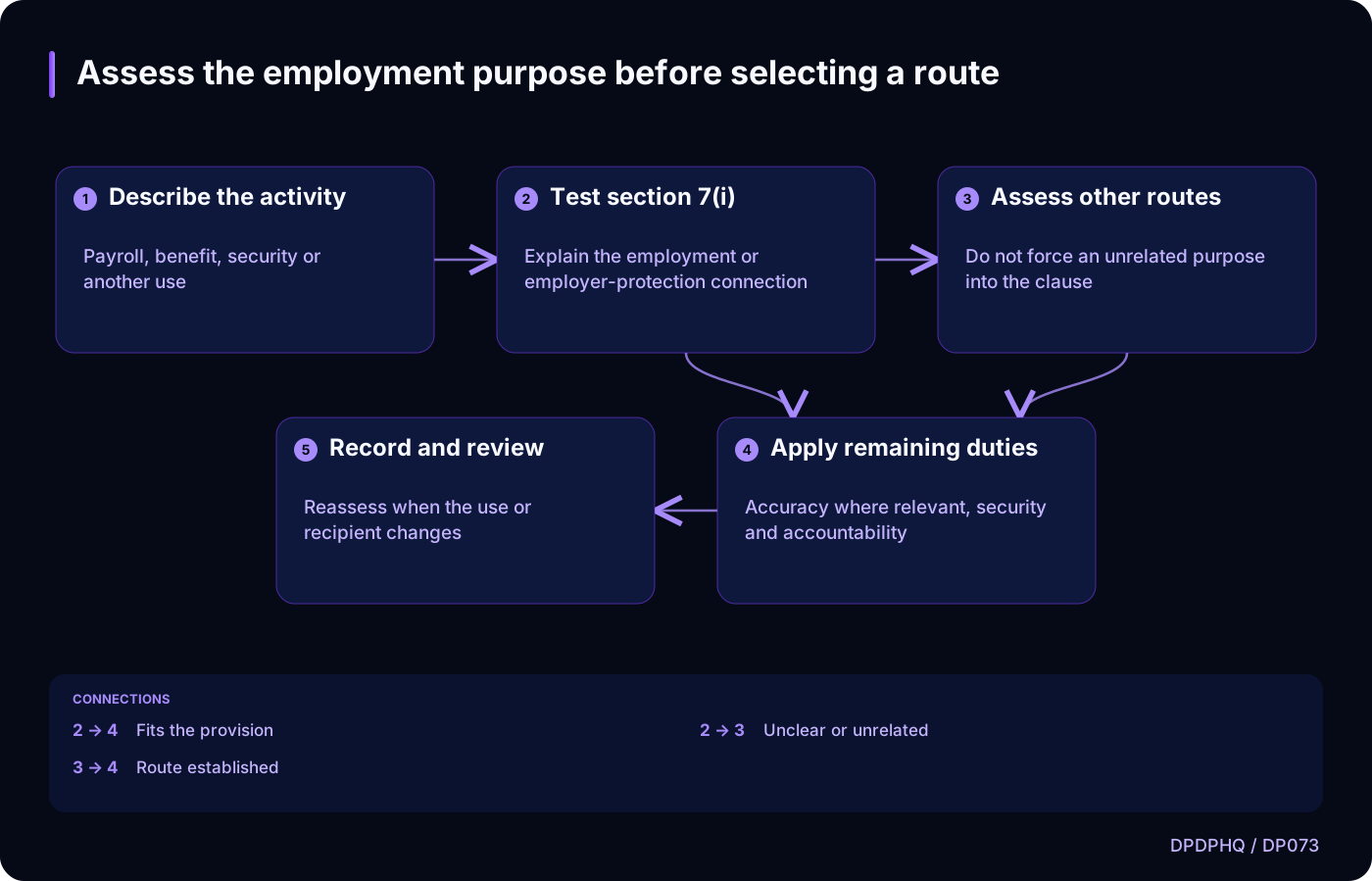
Assess the employment purpose before selecting a route
Text version of the diagram
- Describe the activity: Payroll, benefit, security or another use
- Test section 7(i): Explain the employment or employer-protection connection
- Assess other routes: Do not force an unrelated purpose into the clause
- Apply remaining duties: Accuracy where relevant, security and accountability
- Record and review: Reassess when the use or recipient changes
- Describe the activity → Test section 7(i)
- Test section 7(i) → Apply remaining duties: Fits the provision
- Test section 7(i) → Assess other routes: Unclear or unrelated
- Assess other routes → Apply remaining duties: Route established
- Apply remaining duties → Record and review
Sources and reading context
These references support the original 22 October 2026 research. Source links and the date above make the scope of this article explicit.
- Commencement notification for provisions of the DPDP Act · paragraph (c)
Dates the substantive duties
- Digital Personal Data Protection Act, 2023 · sections 4, 7(i), 8(1), 8(3), 8(5)
Grounds, employment scope and continuing responsibilities
- Digital Personal Data Protection Rules, 2025 · rule 6
Security safeguards