Foundations and commencement · DP006
The personal and domestic use exception, explained carefully
Understand when an individual acts for a personal or domestic purpose, and why family contacts, neighbourhood groups and side businesses need separate analysis.
Research cutoff: . This dated explainer is general information; check the linked instruments and your circumstances before acting.

Your phone can contain a family address book, a neighbourhood group and the customer list for a weekend business. The device is the same, but the purposes are different. That distinction is central to the DPDP Act’s personal or domestic use exception.
Section 3(c)(i) excludes personal data processed by an individual for a personal or domestic purpose. It does not exclude every activity carried out on a privately owned phone. As of 22 October 2026, section 3 is scheduled for the May 2027 commencement phase; use the official timetable when describing this as preparation for the framework.
The purpose belongs at the centre
Keeping a sibling’s address for a family visit is an ordinary example of personal use. Maintaining an address list to fulfil paid orders is a business activity, even if the business is small and operated from a kitchen. Neither the price of the phone nor the informality of the activity answers the legal question.
Start by writing a plain sentence: “I use these details to…” If the sentence ends with organising family life, the personal or domestic exception may be relevant. If it ends with managing customers, selling services or running an organisation, do not assume the same exception applies.
Some situations need closer judgement. A neighbourhood volunteer might organise a one-off gathering, administer a formal residents’ association or operate a paid service. The relationships, purposes and actual processing differ. The short statutory wording does not provide a universal answer for every community group.
A hypothetical home-bakery boundary
Imagine Meera keeps friends’ birthdays in her calendar. She also runs a small bakery. When a friend places a paid order, Meera records a delivery address, allergy-related instructions and payment status in an order spreadsheet.
The birthday calendar and the order spreadsheet should be assessed separately. A personal relationship with the buyer does not turn every commercial transaction into domestic processing. Nor does the business need to classify all of Meera’s private contacts as customers merely because some friends buy cakes.
The boundary becomes less clear operationally when Meera copies her entire private address book into a promotional tool. The new marketing purpose must be assessed on its own facts. The original personal collection does not automatically authorise the later business use or keep it within the exception.
Keep personal and business records distinguishable
A separate business account or address book can help, but the separation needs to match behaviour. If staff continue using the owner’s personal inbox for orders, the label on the account will not resolve where the records actually sit.
Useful controls include a dedicated order channel, a shared business system with named access, and an instruction about which conversations belong in the order record. These are recommended working practices, not technologies expressly mandated by the exception.
For a very small operation, start with a clear customer register and a routine for moving relevant order details into it. Avoid copying unrelated family messages. Make it possible for a colleague to process an order without gaining access to the owner’s private conversations.
The exception is not a general permission slip
Being outside a particular DPDP scope provision does not establish that every disclosure is acceptable under every other law or relationship. Publishing private information, misusing another person’s credentials or breaching a contractual duty raises different questions. The exception should not be advertised as legal immunity for personal behaviour.
It also should not be confused with the separate public-availability exclusion. A family phone number can remain private while used domestically. A public post can involve an entirely different analysis. Keep the statutory exclusions separate instead of combining them into a broad “informal data” category.
A decision record for uncertain cases
For a side business or community activity, note the person conducting the processing, the purpose, the people whose information is involved, any organisational role and any paid service. Record which facts support the proposed treatment and which facts remain uncertain.
Review that decision when the activity changes. A personal invitation list can become a membership database; an unpaid favour can become a recurring service. The original assessment may no longer describe the current use.
The goal is not to make private life resemble corporate compliance. It is to avoid carrying a narrow exception across a boundary it was not designed to settle. When personal and business life share devices and relationships, an activity-level assessment gives the owner a clearer answer than treating everything on the phone as one category.
One phone, different purposes
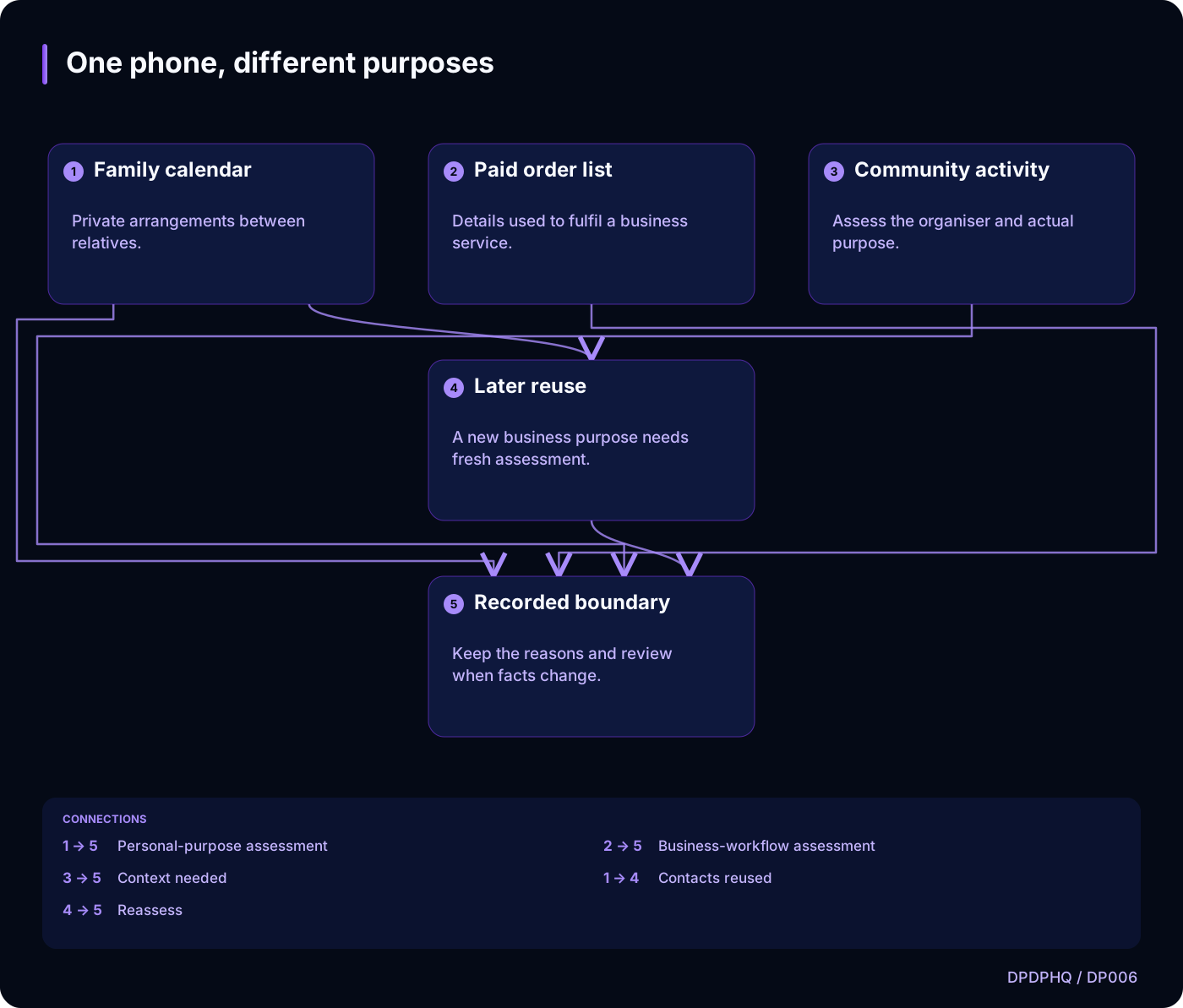
Text version of the diagram
- Family calendar: Private arrangements between relatives.
- Paid order list: Details used to fulfil a business service.
- Community activity: Assess the organiser and actual purpose.
- Later reuse: A new business purpose needs fresh assessment.
- Recorded boundary: Keep the reasons and review when facts change.
- Family calendar → Recorded boundary: Personal-purpose assessment
- Paid order list → Recorded boundary: Business-workflow assessment
- Community activity → Recorded boundary: Context needed
- Family calendar → Later reuse: Contacts reused
- Later reuse → Recorded boundary: Reassess
Sources and reading context
These references support the original 22 October 2026 research. Source links and the date above make the scope of this article explicit.
- Digital Personal Data Protection Act, 2023 · Section 3(c)(i)-(ii)
Separate scope exclusions
- Commencement notification for provisions of the DPDP Act · Paragraph (c)
Scope commencement