Rights and grievances · DP022
The right to nominate someone: an operational guide
Prepare a nomination process that records the individual’s choice and verifies a later trigger, while keeping privacy rights separate from inheritance and account ownership.
Research cutoff: . This dated explainer is general information; check the linked instruments and your circumstances before acting.

When a person dies or becomes unable to exercise their rights, an organisation may receive requests from family members who assume they can act for the account holder. DPDP nomination creates a specific rights mechanism, but it should not be confused with ownership of money, inheritance or unrestricted access to an account.
Section 14 of the Act provides for nomination of another individual to exercise DPDP rights on death or incapacity. The definition of incapacity concerns inability to exercise those rights due to unsoundness of mind or infirmity of body. As of 22 October 2026, the provision and rule 14 are scheduled for May 2027 under the commencement notification.
Separate recording a nominee from activating the role
The first process records the account holder’s nomination. The second evaluates a later request to act following the relevant event. Combining them can lead to premature access or to a nomination that cannot be found when needed.
At the recording stage, explain what nomination does in this context. Capture the details needed to identify the nominee and connect them to the correct person. Rule 14(4) permits nomination of one or more individuals using the relevant means and particulars, in accordance with applicable terms and law.
The final Rules do not provide a universal document pack for every nomination scenario. The business should develop a proportionate process with legal review where necessary, rather than claim that a particular notarised form or identity document is always mandated by DPDP.
A hypothetical account example
Imagine a subscription service lets an adult customer record her brother as a nominee for DPDP rights. The service explains the purpose, confirms the customer’s instruction through an appropriate route and stores a dated record linked to her account.
That entry should not automatically give the brother her password, payment authority or live access to private messages. The nomination concerns exercising rights in the specified circumstances. Other access, contractual and legal questions remain separate.
Later, the brother contacts the service after her death and requests erasure of relevant personal data. The team needs to find the nomination, verify the requester and assess the trigger and requested right. It must also consider lawful retention and other people’s information before deciding what action is appropriate.
Plan for difficult cases before they arrive
The nominee may have changed contact details. Two people may claim authority. The organisation may hold an older nomination and a newer instruction. A request may concern incapacity rather than death, requiring sensitive handling of supporting information.
Assign a trained owner and an escalation route for these cases. Do not let frontline staff resolve competing claims by whoever calls first. Preserve the relevant records while assessing the issue, with access restricted to people who need them.
Request supporting information proportionately and explain what it is needed to establish. Avoid collecting extensive medical or family material merely because it might be relevant. Verification documents can themselves be sensitive and need a defined handling and retention approach.
Keep the scope of the requested right clear
A nominee seeking information, correction or erasure should not automatically receive every record associated with the account. Apply the relevant right and its limits. Access provisions include specific content and exceptions; erasure can be constrained by continuing purpose or legal retention requirements.
Where information concerns another person as well, assess the response carefully. A joint conversation or shared household account may contain details that cannot simply be handed over as though they belong exclusively to the original account holder.
Communicate the outcome in understandable terms. Explain which action was taken and any material limitation, with a grievance route where relevant. Avoid implying that the nomination resolves a family dispute or determines succession to assets.
Make changes and retrieval reliable
Provide a clear way for the individual to review or change the recorded nomination through the service’s process. Keep enough history to understand which instruction is current without allowing outdated entries to drive later decisions.
Test whether authorised staff can locate a nomination when the customer’s usual contact channel is unavailable. Also test whether a routine customer-service search exposes nominee details to staff who do not need them. Availability and confidentiality both matter.
The useful operational design has two distinct safeguards: a reliable record of the person’s own choice and a careful process for using it when the statutory circumstances arise. Keeping those stages separate helps the organisation support people at difficult moments without treating a privacy-rights nomination as a general transfer of the account.
Record a nomination, then assess activation
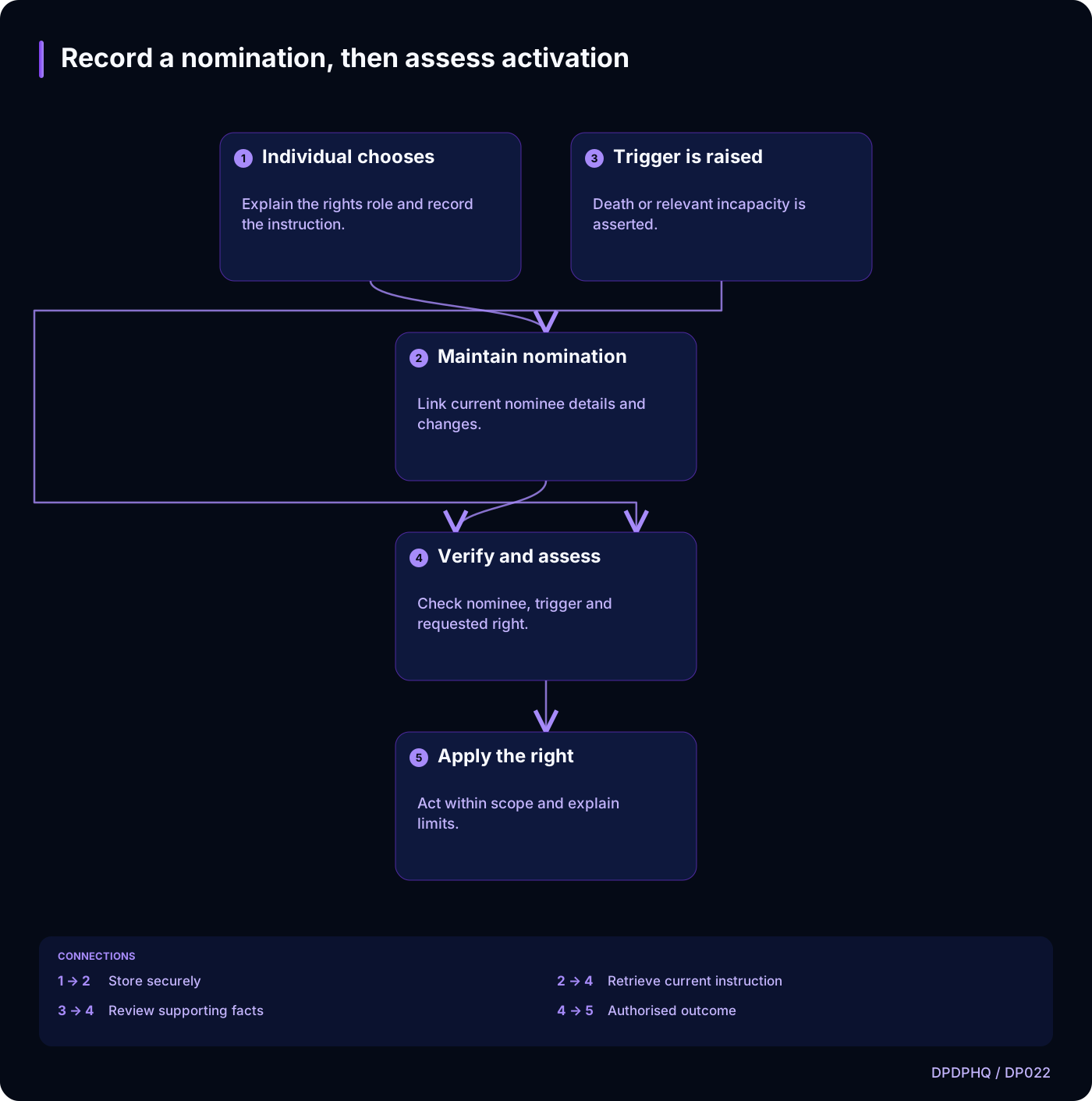
Text version of the diagram
- Individual chooses: Explain the rights role and record the instruction.
- Maintain nomination: Link current nominee details and changes.
- Trigger is raised: Death or relevant incapacity is asserted.
- Verify and assess: Check nominee, trigger and requested right.
- Apply the right: Act within scope and explain limits.
- Individual chooses → Maintain nomination: Store securely
- Maintain nomination → Verify and assess: Retrieve current instruction
- Trigger is raised → Verify and assess: Review supporting facts
- Verify and assess → Apply the right: Authorised outcome
Sources and reading context
These references support the original 22 October 2026 research. Source links and the date above make the scope of this article explicit.
- Digital Personal Data Protection Act, 2023 · Sections 11-14
Nomination and underlying rights
- Digital Personal Data Protection Rules, 2025 · Rule 14(4)
Nomination means and particulars
- Commencement notification for provisions of the DPDP Act · Paragraph (c)
Later rights phase