Education and children · DP070
When an education exemption applies, read its exact conditions
Use a precise class, activity and obligation test before relying on the children-related educational exemption.
Research cutoff: . This dated explainer is general information; check the linked instruments and your circumstances before acting.

‘Educational institutions are exempt’ is an incomplete sentence. It omits the processing activity, the conditions and the particular obligations affected. Those omissions can change the meaning enough to produce a poor product or policy decision.
Use the exemption as a specific legal test. The question is whether this organisation’s proposed processing fits the text, not whether the organisation has an educational mission.
Establish the version and the commencement
The relevant instrument is the final Digital Personal Data Protection Rules, 2025, read with the December 2025 corrigendum. On 22 October 2026, the section 9 and rule 12 provisions are scheduled to commence on 13 May 2027 under the Act commencement notification and rule 1(4) of the final Rules. The assessment is therefore preparation for the notified framework, not a statement that every relevant future duty is already active.
Rule 12 connects the exception to the Fourth Schedule. Part A identifies classes of Data Fiduciaries and attaches conditions. Part B deals with specified purposes and their conditions. Do not combine fragments from different rows into a new, broader exemption.
Step one: identify the class
Part A, item 3 concerns a Data Fiduciary that is an educational institution. The Schedule’s definition includes an institution of learning imparting education, including vocational education. A business should examine its actual role and activity rather than assume that using an education-related brand or selling software to a school establishes the class.
Record which entity is making the decision about the processing. A school and a supplier may have different roles for different activities. The school’s position does not automatically answer the supplier’s use of data for its own unrelated purpose.
Step two: read the activity and purpose together
The item 3 condition concerns processing restricted to tracking and behavioural monitoring for the institution’s educational activities or in the interests of the safety of children enrolled with it. Each part matters: the activity, the institution’s educational purpose, and the enrolled-child safety wording where that limb is relied on.
Do not shorten that condition to ‘all student data’. Admissions promotion, public testimonials and unrelated advertising require their own assessment. A feature described as analytics might support an educational task, or it might create a profile for another commercial purpose. The label does not resolve the distinction.
Where a system serves several purposes, separate them. An exception that applies to one activity should not silently travel with the same data into a different activity.
Step three: identify which obligations are affected
The exception in rule 12 addresses section 9(1) and section 9(3) within its scope. It does not remove section 9(2)’s restriction on processing likely to harm a child’s wellbeing. It also does not announce a blanket exclusion from the rest of the DPDP framework.
Your assessment should therefore name the affected provisions and the responsibilities that remain. Keep security, purpose, accountability and the relevant general framework in view. The right conclusion is a bounded statement about a particular activity, not a certificate that the institution is exempt.
Apply the test to a hypothetical school tool
A school proposes a tool that tracks progress through assigned learning exercises so teachers can identify where enrolled students need support. The team documents the specific tracking, its educational task, the institution involved and the relevant conditions. It then examines the remaining wellbeing and other responsibilities before deciding how the tool should operate.
The supplier later proposes using the same activity data to build promotional audiences for unrelated courses. That proposal creates a separate purpose. The earlier educational assessment does not automatically cover it. The school asks for a fresh analysis and prevents the secondary use while it is unresolved.
This example illustrates the method, not a legal conclusion for every learning platform. The details of the actual processing and the parties’ roles can change the answer.
Keep the assessment revisitable
Create a short decision record containing the source version, the entity, the activity, the purpose, the exact condition relied on, the affected obligations and the person responsible for review. Attach the relevant product description or data-flow evidence so a later reviewer can see what was assessed.
Set change triggers. A new audience, recipient, feature or commercial use may move the processing beyond the original reasoning. A broad statement in an old policy will not reveal that change.
The practical benefit of reading the condition precisely is clarity. Teams can explain what they intend to do, why the exception may apply and which controls remain necessary. That is a much stronger basis for a decision than a reassuring but incomplete exemption label.
Test the exemption in a fixed order
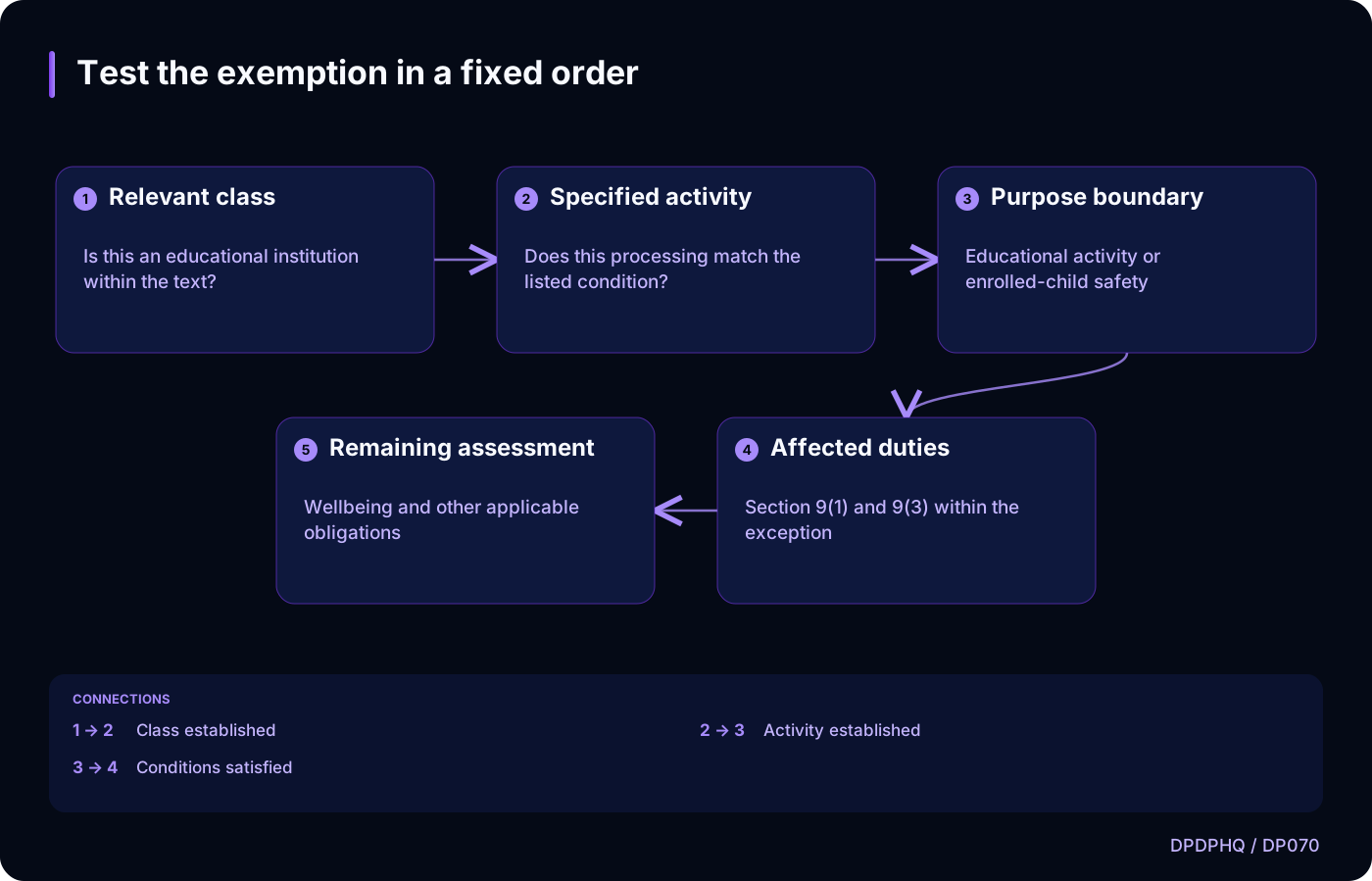
Text version of the diagram
- Relevant class: Is this an educational institution within the text?
- Specified activity: Does this processing match the listed condition?
- Purpose boundary: Educational activity or enrolled-child safety
- Affected duties: Section 9(1) and 9(3) within the exception
- Remaining assessment: Wellbeing and other applicable obligations
- Relevant class → Specified activity: Class established
- Specified activity → Purpose boundary: Activity established
- Purpose boundary → Affected duties: Conditions satisfied
- Affected duties → Remaining assessment
Sources and reading context
These references support the original 22 October 2026 research. Source links and the date above make the scope of this article explicit.
- Commencement notification for provisions of the DPDP Act · paragraph (c)
Dates section 9 in the substantive phase
- Digital Personal Data Protection Act, 2023 · sections 9(1) to 9(4)
Defines duties and exemption power
- Digital Personal Data Protection Rules, 2025 · rules 1(4) and 12; Fourth Schedule Part A item 3 and definitions
Provides exact education condition and scope
- Corrigenda to the Digital Personal Data Protection Rules, 2025 · Fourth Schedule lettering correction
Uses the corrected schedule context