Foundations and commencement · DP005
Digital records, paper forms and the point where DPDP applies
Trace how a paper form becomes digital personal data through scanning, spreadsheets and messaging, and build a handoff that preserves purpose and ownership.
Research cutoff: . This dated explainer is general information; check the linked instruments and your circumstances before acting.

A paper form can enter a digital system without anyone calling it a digitisation project. A receptionist photographs it, a supervisor types its contents into a spreadsheet, or an accountant receives a scan by email. Each route creates a new record and a new set of people who may access it.
For DPDP preparation, the important distinction is the actual processing. Section 3(a) includes personal data collected digitally and personal data collected in non-digital form and subsequently digitised. As of 22 October 2026, that scope provision and the main duties are scheduled for the May 2027 phase under the commencement notification.
Map the journey from the first copy
Take a hypothetical vehicle-service centre. Customers complete a paper intake form with contact details, vehicle information and a fault description. A service adviser enters those details into a booking application. Later, somebody photographs the form to resolve a billing question.
The booking entry is digital personal data if it identifies the customer. The photograph may also contain identifiable information. Keeping the original on paper does not make these digital copies disappear from the assessment. Equally, the DPDP Act’s digital scope should not be restated as a universal regulation of every paper-only file.
The centre should record both the original collection method and the later digital destinations. This avoids a common inventory error: listing the booking application while missing the staff phone and email attachment that contain the same information.
A form can have more than one destination
Before scanning a form, decide what the digital copy is meant to achieve. Is it a searchable customer record, evidence of a signed instruction, a temporary working copy or an attachment for a dispute? The answer affects access, retention and whether the whole page is needed.
If a finance team needs an invoice number and approved amount, sending a complete intake form with unrelated personal notes may be unnecessary. If the business needs evidence of an authorisation, a structured field alone may be insufficient. Choose the copy that serves the real purpose, and explain that choice in the workflow.
These are practical design decisions. The Act’s prospective consent provision limits consent to data necessary for the specified purpose; it does not prescribe a single scanning format or file-naming system. The notice and consent provisions are the legal reference, while the operating procedure translates them into the service centre’s work.
Give staff a clear capture rule
An instruction such as “be careful with forms” leaves too much to interpretation. A more useful rule tells staff which approved system to use, which fields to enter, when an image is justified and where temporary copies must go afterwards.
For the service centre, the rule might say that booking details are entered directly into the service application, authorisation images belong in the restricted job folder, and routine copies must not remain in personal messaging threads. This is a hypothetical control design, not a universal statutory checklist.
Someone should also check transcription errors. A mistaken phone digit can send updates to another person. A wrongly associated job number can attach one customer’s complaint to somebody else’s account. Where data is likely to be used to make a decision affecting the person or disclosed to another fiduciary, section 8(3) requires accuracy, completeness and consistency in that context.
Do not promise deletion before checking the copies
If a customer asks for erasure, searching only the application may miss the scan, email and exported report. Conversely, deleting every copy immediately may conflict with a legitimate retention requirement. The final Rules include retention provisions that must be reconciled with erasure, including the at-least-one-year retention for Seventh Schedule purposes under rule 8(3).
Prepare a simple location map and distinguish routine use from restricted retention. The fact that a record must remain for a defined reason should not automatically keep it available to sales staff or on an employee’s phone. Record who can authorise disposal of the original and the digital versions.
Test one complete journey
Select a closed job and ask a colleague to find every authorised copy using the procedure. Can they identify the purpose, owner and retention rule without asking the person who created it? Can they tell whether an image is the final record or a temporary duplicate?
Use the result to improve the handoff between reception, operations and finance. A paper-to-digital workflow becomes manageable when the business knows why the digital version exists, where it belongs and who is responsible for its eventual correction, restriction or deletion. The scanner is only one step in that journey.
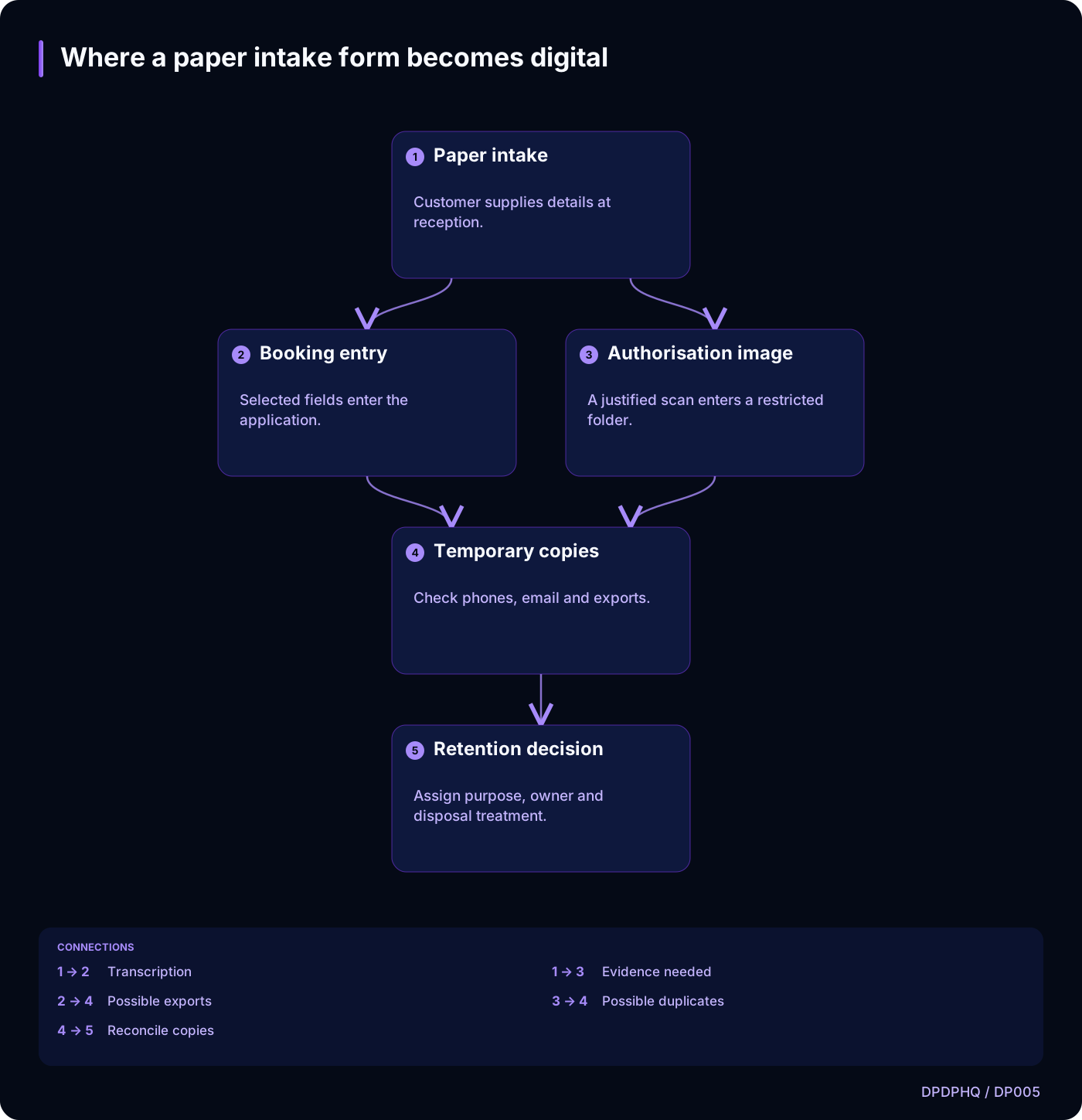
Where a paper intake form becomes digital
Text version of the diagram
- Paper intake: Customer supplies details at reception.
- Booking entry: Selected fields enter the application.
- Authorisation image: A justified scan enters a restricted folder.
- Temporary copies: Check phones, email and exports.
- Retention decision: Assign purpose, owner and disposal treatment.
- Paper intake → Booking entry: Transcription
- Paper intake → Authorisation image: Evidence needed
- Booking entry → Temporary copies: Possible exports
- Authorisation image → Temporary copies: Possible duplicates
- Temporary copies → Retention decision: Reconcile copies
Sources and reading context
These references support the original 22 October 2026 research. Source links and the date above make the scope of this article explicit.
- Digital Personal Data Protection Act, 2023 · Sections 3(a), 5, 6(1) and 8(3)
Digital scope, necessity and accuracy
- Commencement notification for provisions of the DPDP Act · Paragraph (c)
Substantive commencement
- Digital Personal Data Protection Rules, 2025 · Rule 8(3)
Retention reconciliation